
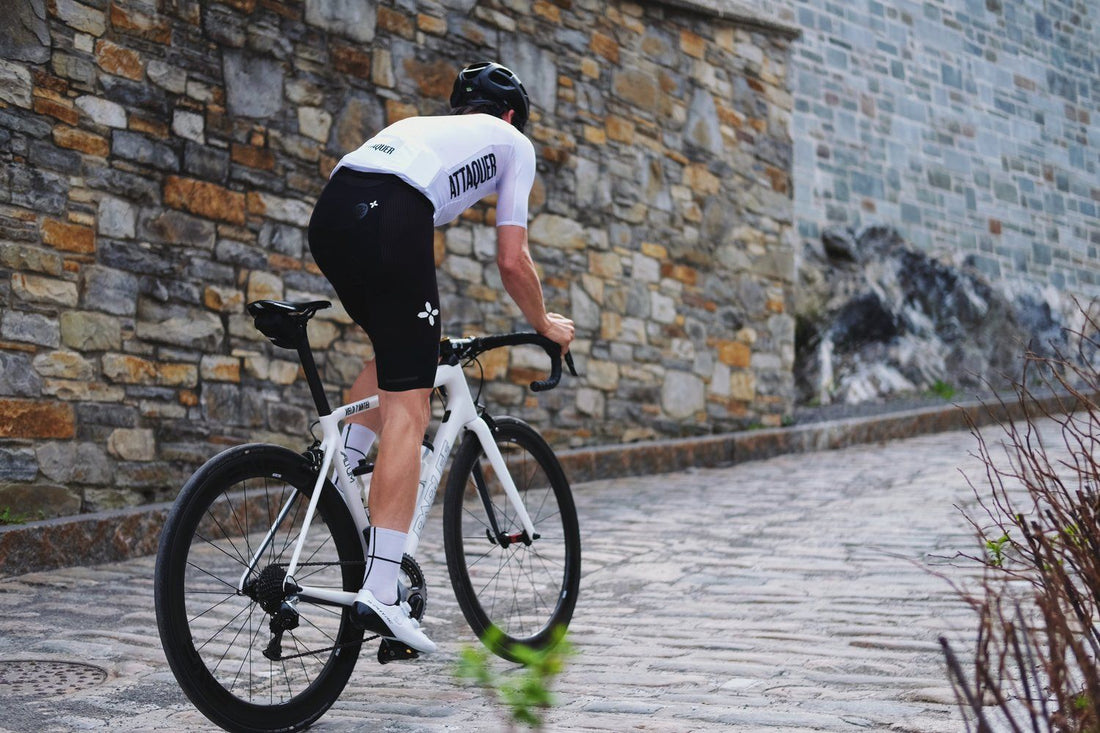
Hill training in Quebec City
Climbing. You can prepare for this indoors. Many of our indoor training sessions perfectly mimic the type of effort required to climb hills. However, the effect of gravity caused by the slope is difficult to reproduce.
Hence the importance of hill training to excel—or simply survive!—when the road climbs.
Depending on where you live, we have selected three training routes with similar profiles in the Quebec City area.
Here they are, with their associated Strava segments:
Church Hill in Boischatel https://www.strava.com/segments/1112215
Côte Gagnon in Saint-Augustin-de-Desmaures https://www.strava.com/segments/1184432
Church Hill in Sillery https://www.strava.com/segments/7368506


Targeted efforts
The goal when doing specific exercises on this type of road segment is either to improve your VO2max (PAM) or to work on youranaerobic lactate capacity (the equivalent of CP1minute). Since VO2max is the main factor in cycling performance, it is the one that will be primarily challenged in the intervals I suggest you try here.
Repeat, compare, measure improvement
According to performance data collected by Strava, these segments take between 2 and 3 minutes for KOM and QOM holders .
Since you will want to repeat the effort several times during the same workout, you will need at least 2 minutes to complete them, hence the length of each proposed protocol plus Socks, set at 120 seconds.
After these 2 minutes, to avoid exhausting yourself by climbing to the top each time, climb back down and repeat the exercise from the beginning.
By using a Power Meter and comparing your different efforts (on Strava, for example) over several weeks during which you have repeated the same protocol at regular intervals, you will be able to measure your progress on these VO2max efforts.
Protocol 1:
Attack the Socks at full power, at 105-110% MAP, for 30 seconds. Then return to 85-90% MAP for 1 minute and finish strong at 110% MAP and above toreach the summit.
Protocol 2:
Approach the hill at a high tempo (75 to 80%of your maximum aerobic power on the flat section before the hill, about 30 seconds), launch your attack (about 30 seconds at the foot of the hill at around105-110% MAP), maintain 45 seconds at90-95%, then return just below VO2max, at a high tempo (80-85%), to finish the last 15 seconds of the effort.
Protocol 3:
Try to maintain an average power output between 95and 105% throughout the climb.
Find the method that works for you
You can repeat the exercises depending on the time you have available and your ability to resume them effectively, following the chosen protocol(s). You can alternate between protocols during the same workout.
For example, do 1, then 2, then 3. And start again. This gives a total of 6 repetitions, or 12 minutes at VO2max. Allow 4 minutes of active recovery between each effort. If your average power output during the 2-minute efforts decreases by more than 10-12% (e.g., from 300W to 270W or less), it is best to finish the endurance training and go home, as you are no longer working the right energy system (VO2max) due to a lack of glycogen (energy).
Otherwise, identify your weaknesses and work on them. If you struggle to maintain consistent power, work on protocol 3. If you tend to lose momentum on Socks bosses, focus on protocol 2. If your finish lacks punch, protocol 1 should help you improve significantly.
Don't hesitate to experiment to improve your performance. Vary your cadence, add or remove a gear, try sitting when you usually stand, or vice versa. Now is the timeto explore all the possibilities to become a formidable climber. Or a relentless climber.