
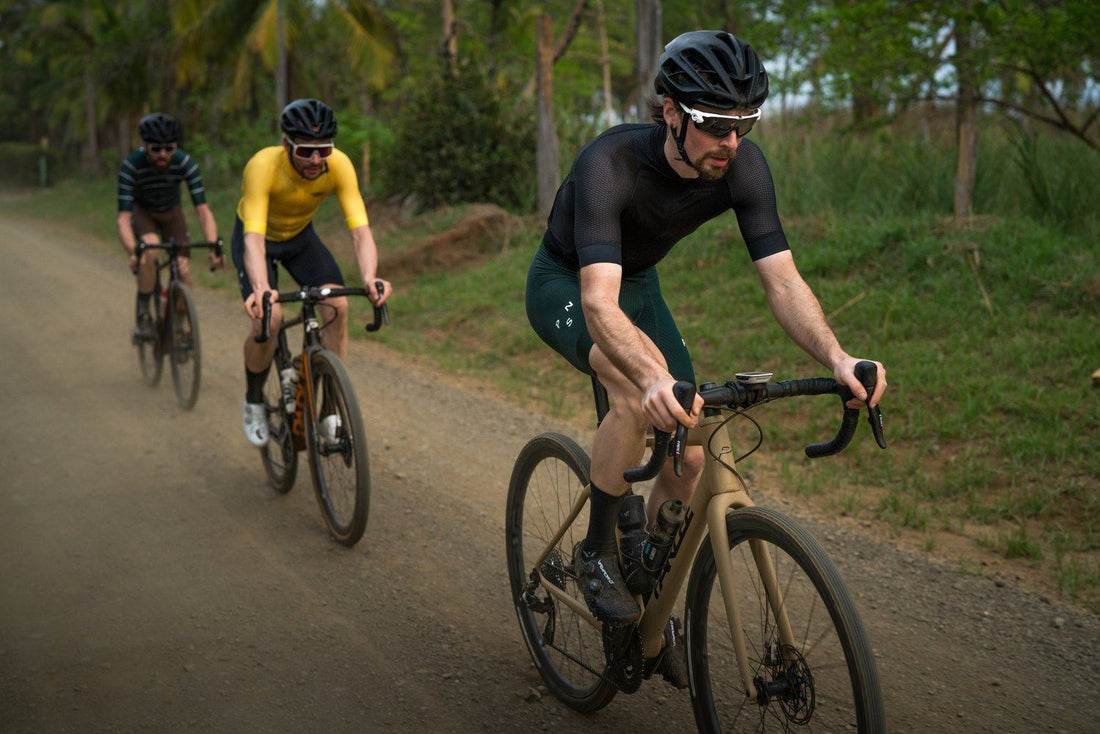
Gravel training
Gravel bike races are becoming increasingly popular and attracting a growing number of enthusiasts. This is hardly surprising: these races are open to all, mostly individual, much less strategic than road races, and just as enjoyable for those at the back of the pack as for the powerhouses sprinting ahead.
So you might want to win them, or make them a personal challenge. And everyone benefits. What's more, you get to discover some stunning landscapes.
But these are also demanding courses, requiring a certain level of concentration, good technical skills, and preparation that is slightly different from that required for road racing. All this because you are riding on different terrain. Every time.
Specific training
It's not just the specific nature of the effort that counts here. As Canada's new unofficial gravel bike champion, our very own Bruno Langlois emphasizes the importance of doing as muchtraining as possibleon the ground to get used to it. "And to put the equipment to the test too! We want to try different gear ratios, Tires types Tires different pressures." Grip is king here.
“Specific trainingalso means preparing yourself to tackle a particular type of terrain.”
Turns, descents, climbs: all of these are handled very differently than on the road. And unless you are an experienced mountain biker, it is best to get used to this new riding style before the race.
Physical preparation
Since the ground is often loose, you don't get the same traction on gravel as you do on asphalt. The main consequence of this is that you sometimes have to tackle steep climbs with force, sitting on the bike.
Coach Bruno has therefore devised a specific training plan for this type of event.
"All the exercises here are done at a very low cadence, around 60-70 RPM, unless you have knee problems," he explains. "In that case, you can do tempo-type exercises at a low cadence, but not those that require a lot of power."
"However, it's still important to work on these areas. So, for example, we will do VO2 max and anaerobic training by alternating between a fraction of effort at 60-75 RPM and another at 90-100 RPM. This model is based somewhat on the principle of load contrast (heavy/light) used in strength training at the gym."
Here is a four-week plan. The last week will be devoted to sharpening. Each skill is practiced once a week. (See the program plus Socks.)
The plan explained

"The first area to work on is endurance strength," explains Bruno. "We want each workout of this type to total 30 to 40 minutes of effort between 80 and 95% of CP20."
"Over the weeks, we increase the effort and reduce recovery time so that it resembles a prolonged effort, like in a race."
For high-intensity, high VO2 work, we continue to "grind" on high gears, alternating between 60-70 RPM and 90-100 RPM. "This time," Bruno tells us, "we want to total 15 to 20 minutes of effort between 90-100% of CP5."
For example, you would repeat a series of five 1-minute efforts with 1 minute of rest three times. The following week, you would add one more effort (i.e., 3 x 6). And so on.
Finally, for anaerobic exercise, the same principle applies, without exceeding a total of 10-12 minutes of effort lasting 30 to 45 seconds at 80-90% of CP1.
"All other rides are done in zone 1, REALLY slowly, to recover properly and be able to benefit from the effort. If you go out for a 3-hour run at a moderate pace, you'll be too tired the next day to do the exercises properly."
And for the last week, the coach explains, we reduce the total time of the intervals by half and reduce the total volume by 50%. "We increase the full recovery time between efforts and reduce their number. And then, he insists, we take two days of TOTAL REST during the week."
The program
Here is what Bruno's program might look like. However, a training program is not a prescription: there is no point in pushing yourself too hard and doing very intense exercise if you feel very tired, as you will end up doing it poorly and not achieving the desired results.
You need to listen to your body and adjust your schedule as needed. And if you're unsure, it may be a good idea to hire a coach who can tailor your program to your needs.
Also, your baseline values (FTP, CP20, CP5, and others), which are used to determine your power output, may have changed over the past few months. Before starting a program, it's best to retake the tests to make sure you're doing things right.
Each workout session includes a gradual warm-up (30% to 100% of CP20) lasting 10 to 15 minutes, as well as a cool-down lasting at least 5 minutes (less than 50% of CP20).
If you need advice or want a customized version, please email blanglois@velocartel.cc.
WEEK 1
Monday: Passive rest
Tuesday: VO2 max (strength endurance)
3 sets of 5 x 1 min @ 90-100% CP5; alternate 1 @ 60-75 RPM and 1 @ 90-100 RPM / 1 min recovery @ 30-50% CP20 @ 90-100 RPM
Rest 3 min @ 30-50% CP20
Wednesday: Endurance
1.5-2 hours @ 50-75% CP20
Thursday: Tempo (strength endurance)
6 x 5 min @ 80-90% CP20 @ 60-75 RPM / 3 min recovery @ 30-50% CP20
Friday: Active recovery
1h30 @ 55% CP20
Saturday: Anaerobic (power strength)
3 sets of 6 x 30 s @ 80-90% CP1; alternate 1 @ 60-75 RPM and 1 @ 90-100 RPM / 2 min recovery @ 30% CP20 @ 90-100 RPM
Sunday: Endurance
3 hours @ 50-75% CP20
WEEK 2
Monday: Passive rest
Tuesday: VO2 max (strength endurance)
3 sets of 6 x 1 min @ 90-100% CP5; alternate 1 @ 60-75 RPM and 1 @ 90-100 RPM / 1 min recovery @ 30-50% CP20 @ 90-100 RPM
Rest 3 min @ 30-50% CP20
Wednesday: Endurance
1.5-2 hours @ 50-75% CP20
Thursday: Tempo (strength endurance)
6 x 6 min @ 80-90% CP20 @ 60-75 RPM / 3 min recovery @ 30-50% CP20
Friday: Active recovery
1.5 hours @ 55% CP20
Saturday: Anaerobic (power strength)
3 sets of 7 x 30 sec @ 80-90% CP1; alternate 1 @ 60-75 RPM and 1 @ 90-100 RPM / 1min30 recovery @ 30% CP
Sunday: Endurance
3:30 @ 50-75% CP20
WEEK 3
Monday: Passive rest
Tuesday: VO2 max (strength endurance)
2 sets of 10 x 1 min @ 90-100% CP5; alternate 1 @ 60-75 RPM and 1 @ 90-100 RPM / 1 min recovery @ 30-50% CP20 @ 90-100 RPM
Rest 3 min @ 30-50% CP20
Wednesday: Endurance
1.5-2 hours @ 50-75% CP20
Thursday: Tempo (strength endurance)
5 x 8 min @ 80-90% CP20 @ 60-75 RPM / 3 min recovery @ 30-50% CP20
Friday: Active recovery
1h30 @ 55% CP20
Saturday: Anaerobic (power strength)
3 sets of 8 x 30 s @ 80-90% CP1; alternate 1 @ 60-75 RPM and 1 @ 90-100 RPM / 1min30 recovery @ 30% CP 20
Sunday: Endurance
4 hours @ 50-75% CP20
WEEK 4
Monday: Passive rest
Tuesday: VO2 max
2 sets of 5 x 1 min @ 90-100% CP5 / 2 min recovery @ 30-50% CP20 @ 90-100 RPM
Rest 5 min @ 30-50% CP20
Wednesday: Passive rest
Thursday: Tempo
3 x 6 min @ 80-90% CP20 @ 90-100 RPM / 5 min recovery @ 30-50% CP20
Friday: Active recovery
1 hour @ 30-55% CP20
Saturday: Pre-competition activation
4 x 1 min @ 90-100% CP5 @ 90-100 RPM / 3 min recovery @ 30% CP20
5 min active rest
6 x 30 s @ 70-80% CP1 @ 90-110 RPM / 2 min recovery @ 30% CP20
5 min active rest
3 x 10 s sprint @ 120-140 RPM low gear
Sunday: Competition