
You might say that this is a contradictory title for a training center based on power. And I would reply: not at all. At BL Coaching, we know that performance is not solely linked to power. The proof: it is not always the person who pushes the most watts who wins the race, far from it. So why do we use watts for training? Let me explain.
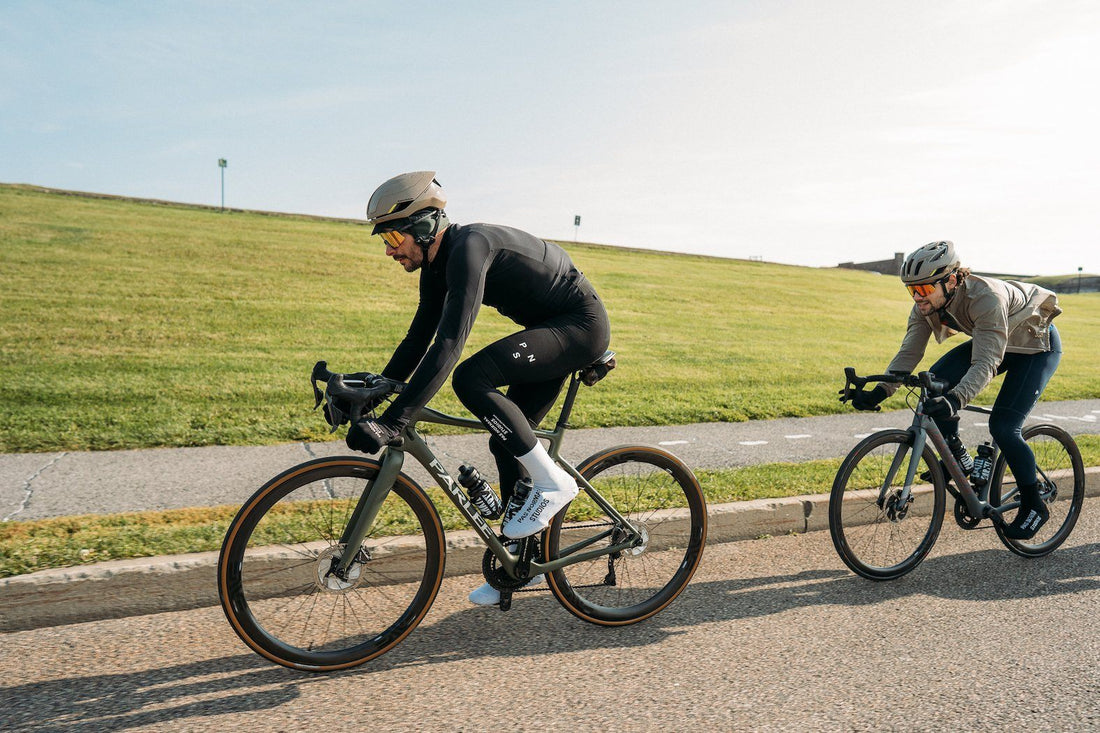
There's more to life than watts
The base
Power is a unit of measurement that uses the torque and rotational speed (RPM) of a machine. The mathematical formula for determining power is as follows:
P[Watts] =
The only way cyclists can measure their power is with a Power Meter meter. This tool can be installed in various places on the bike: in the rear wheel, in the Crankset arm, Crankset in the pedals. In short, anywhere where it is possible to mechanically measure the torque (TQ) exerted by the cyclist and their leg speed (RPM). This instrument reads power in real time and displays it on a monitor (often attached to the handlebars of the bike). This allows you to review the effort you put in during your ride with software such as TrainingPeaks, Strava, GoldenCheetah, or others.
Power is the most accurate measure a cyclist can use for training. If the watts are there, there's no doubt that you're in good shape. If the watts are Socks, you may be tired or not in such good shape.
Why isn't it just watts that matter?
As you can see, power is not related to pure speed. To give a simple example, let's say that a machine can be very powerful and not move at all. It is therefore difficult to make a direct link between the power and speed of a machine (a cyclist in this case).
Speed in watts
It is important to note that several other factors come into play when it comes to performance. That is why it is not necessarily the cyclist who pushes the most watts who will win a race. For example, in triathlons or time trials, aerodynamics are an important factor in performance. In criterium races, the cyclist who stays in the pack and attacks at the right moment has a much better chance of winning than the one who takes the lead and puts up "big numbers." In mountain biking, technique and maintaining momentum in turns and descents can determine the outcome of a race.
In a race, I try to keep my power as low as possible.
— Pete Morris, Clif Bar Pro Team
We often talk about gaining watts or saving watts, but what really matters is gaining speed. The winner of the race is the one who crosses the finish line first, not the one who pushes the most watts (lucky for me, because I would never have won a race in my life!). Power is just a tool, an indicator of how the body is performing. It does not dictate performance.
Why do we train with power in the first place?
The answer is simple: to improve.
Here are the three main reasons why it's good to train with a Power Meter.
Pushing one's limits
One of the factors that limits cyclists the most is their perception of effort. Very few people have the ability to really push themselves to the limit. Perception of effort is a psychological factor that can be improved with power-focused training. By spending more time in a certain zone, it will seem easier because the athlete will be used to sustaining it. In other words, the more time the athlete spends in an uncomfortable zone, the more comfortable it will seem. The perception of effort is pushed back, allowing the athlete to push themselves even harder.
Work on your weaknesses
Everyone has their strengths on the bike. Some call themselves climbers, others rouleurs or sprinters. However, to win (or survive) a race, you have to get over the hills, ride fast, and be able to respond to attacks. So you have to be able to cope in each of these areas.
Power training allows you to identify your weaknesses through a series of tests. You can then work on improving them or continue to build on your strengths. We often hear about power at CP1, CP5, and CP20; these values refer tocritical power over a given time (1 minute, 5 minutes, 20 minutes).

Sagan, "the sprinter," wearing the best Jersey . An image that speaks volumes about the versatility required of any good rider.
Maintaining the right power at the right time
In my opinion, one of the greatest strengths of power training is that it develops the ability to always ride at the prescribed intensity. It's easy to ride too hard during an Ride or not hard enough when you need to step on the gas. The Power Meter reminds Power Meter to take it easy or step it up a notch. It's important to stick to your training zones so you don't overachieve.
The Power Meter your best friend when riding solo . On the other hand, don't hesitate to look up and follow the peloton during a Ride or race. Your gut feeling is probably the best indicator in this type of event.

Before taking his place at the start, Taylor Phinney covers his Power Meter electrical tape. This allows him to ride by feel while still recording his data.
It can sometimes be difficult to tell the difference between pushing hard and going fast. This image is worth a thousand words: a few minutes after this photo was taken, Taylor Phinney was named US time trial champion. Yet he had no idea how many watts he was putting out during the race.
If I had any advice to give, I would say: trust your instincts during the race, work on aspects other than power, and remain critical of your power.
There's more to life than just watts.