
Why tubeless?
When you think about it, apart from bicycles, there are very few wheel systems with tires that still use inner tubes. In fact, apart from wheelbarrows, we can't really think of any.
That said, the tubeless system, which is well suited to tires that only require low air pressure, was until recently not entirely suitable for road use. The Tires still too heavy, they were not always compatible with wheels, and the range of choices was too small to be truly appealing.
However, tire manufacturers are increasingly moving toward a universal standard, while the range of products on offer is exploding. And that's excellent news.
How does it work?
Let's explain things as simply as possible. There are three types of tires:
the Tubulars
clincher tires
tubeless tires
The tube is closed. Its casing, which is glued to the rim, contains an inner tube that is inaccessible except through the valve that passes through the bottom surface and fits into the rim. If it gets punctured, it has to be thrown away. And it's quite expensive. However, it has the advantage of not losing air instantly in the event of a puncture, which means you can still ride for a few miles or avoid ending up with a completely flat tire all of a sudden on a downhill stretch. It is also often the lightest system in the high-end range. And it is very comfortable. For these three reasons, it is still the favorite of professionals and many amateur riders.
The clincher is the most popular system on the market. It is a tire whose beads hook onto the inner walls of the rim. The inner tube is easily replaceable. They come in all qualities, weights, and prices. The main reason for its market dominance is that, for the price, it is still the least complicated system and the easiest to repair on the side of the road or at home.
At first glance, tubeless tires look very similar to clincher tires. In fact, you can even use them with an inner tube (which is still the easiest thing to do in case of a flat tire). Their stiffer beads hook onto the rim walls, just like Tires . However, sealant is added to make them easier to install and to instantly fill any small holes that may be caused by objects on the road. In short, unless they are major, your punctures will repair themselves. This is even better than with a tubular tire.Tubeless Tires alsoallow you to ride at lower pressures than clinchers without increasing the risk of punctures, which improves riding comfort, and they perform better in terms of friction than Tubulars clinchers. This makes them the fastest of the bunch.
Many benefits, few drawbacks
However, the recipe is not yet perfect.
In cyclocross, for example, rims and Tires don't always pair up perfectly. Tires are inflated to very low pressures, often just above 20 PSI, and sometimes a tire X with a rim Y can come off in a rough descent or sharp turn. However, the same rim Y with a tire Z, under the same conditions, could work perfectly.
However, as soon as you increase the pressure, the risk of coming off the rim disappears almost entirely. We say "almost." On gravel, at 40 PSI, with a 40 mm tire, it's not impossible for this to happen if you hit a large rock in a turn. But it's even more likely that this pinch will cause a flat tire with a clincher.
Valves are not always easy to seal, depending on the manufacturer. And due to less than ideal compatibility, installing certain Tires sometimes Tires more difficult.
The final hurdle for tubelesstires is the installation process itself. You need to get some sealant and a special pump or compressor, because a high air flow is required to seat the beads in the rim flanges. This produces an audible pop that tells you your tire is properly seated in its base.
However, we believe that the benefits far outweigh the disadvantages. Admittedly, if you tend to change tires often, depending on conditions, installation may seem more complex. But remember all the times you struggled with clinchers, or all the evenings you spent spreading glue on tubular rims Tubularsonly to wait for them to dry before using them, only to throw them away after the first flat.
And on the road?
Many road cyclists still have doubts about the benefits of switching to tubeless tires. It's true thatpinch flats are less common than in mountain biking, cyclocross, or gravel riding.
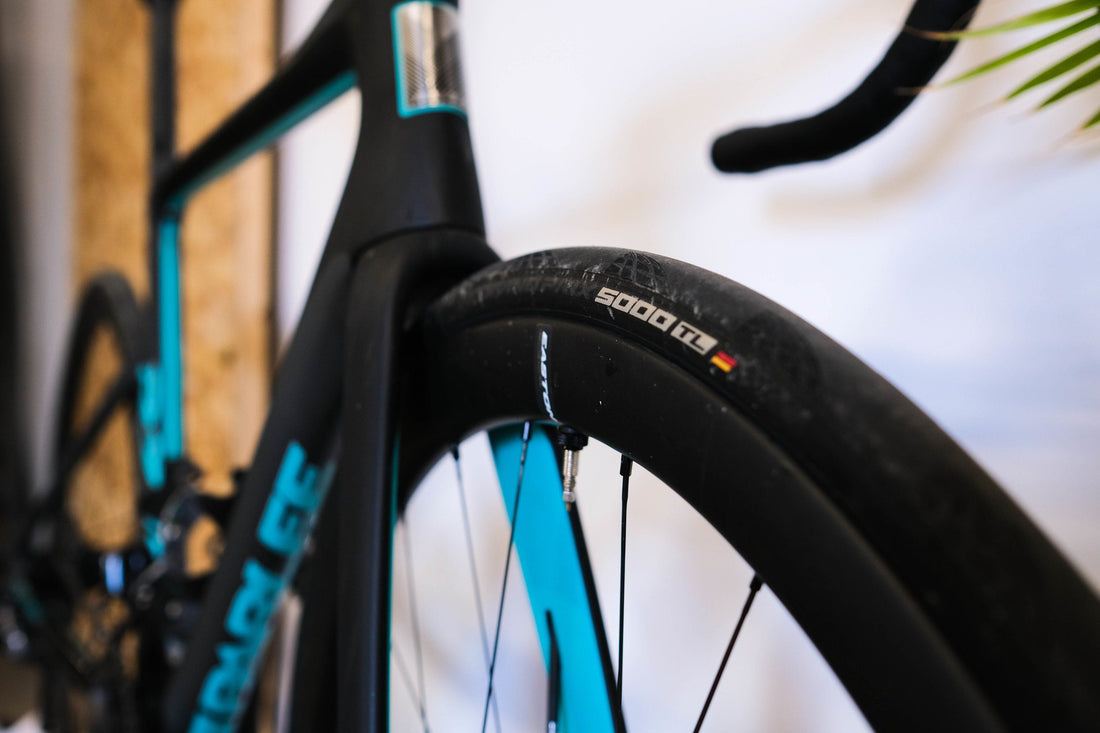
However, their comfort and performance are undeniable. Continental has just adapted its classic Grand Prix for this system, and the result is impressive: durable, resistant, and high-performing, the German manufacturer's GP 5000 is a real success.
In terms of handling, the Schwalbe Pro One is not as durable, but it offers comfort and grip that until now had only been seen on Tubulars (such as the Vittoria Corsa). And it may even be better.
Tubeless wheel manufacturers also suggest lowering the pressure slightly to improve performance. For example, for a weight of 160 lb, Enve recommends inflating tubeless tires to only 63 PSI on SES 3.4 Disc wheels with a 25 mm tire... and only 53 PSI with a 28 mm tire! The result varies slightly from one tire to another, but within a range of 5 PSI variation at most, you get a high-performance and comfortable ride. In high-speed corners, the feeling is incomparable.
Not everything is perfect yet. The system is not yet universally compatible. And tubeless tires require a little more work to install. But with the growing range of products available and the quality of the experience, we believe that tubeless tires are now the leading choice for performance tires.