
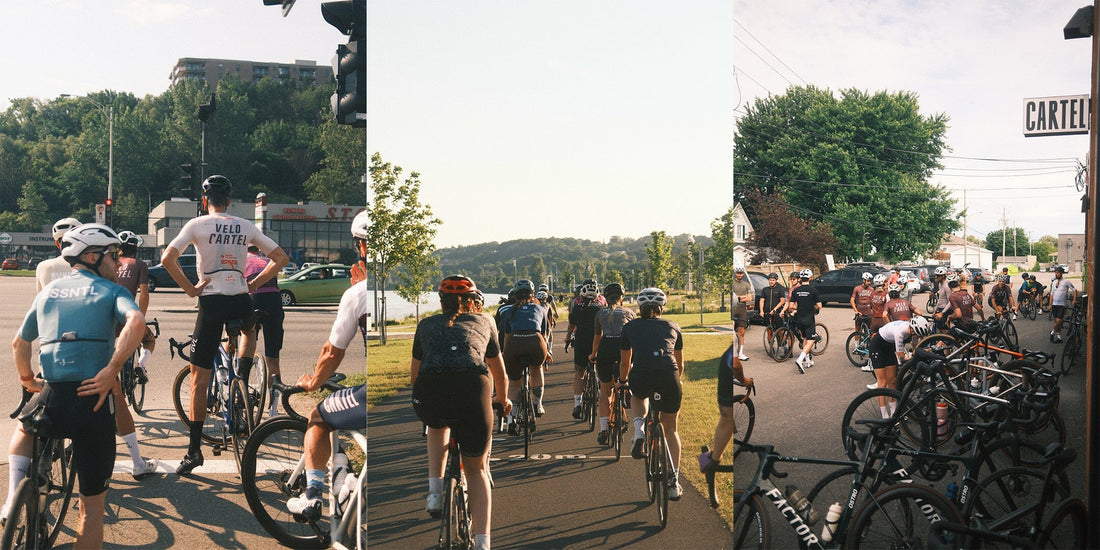
A guide to good manners for group rides
Riding with other cyclists is great fun. Provided you share at least a few basic rules of coexistence that help avoid tension, friction, and above all, accidents.
The existentialist philosopher and author Jean-Paul Sartre (yes, the same one from your philosophy classes in college) wrote that sometimes "hell is other people." Here's what you need to know to avoid being that other person.
A Ride isn't a race...
…unless it is announced as such.
If you join a "drop ride," where the principle is that the best survive at the front and the others get dropped, okay, you can go to the front and give it your all.
Otherwise, if you join the fast group of the day, which is usually made up of experienced cyclists, it may also be tough, but the idea is still to stay together and keep a steady pace. Fast, hard, but steady.
In all situations, if you participate in a Ride and go to the front for 2 minutes and then explode and take refuge in the wheels, not only is there nothing to be proud of, but be aware that experienced cyclists are likely to make fun of you. Or yell at you, because the principle of all rides (with the exception of drop rides, where your ego boost is likely to be very short-lived) is—let's remember—to stay together, so as not to break up the pack.
Sign up for a race if you want to see what you're really made of.
Be more vigilant than usual.
When riding solo or in a very small group, it is easier to assess the risks posed by traffic and street furniture.
When there are more people in front, they must take the size of the group into account in their decisions. For example, when crossing a main road, a path with heavy traffic, or fast-moving traffic.
Since it's not a race, we wait, we take the time to properly assess the risk, and we remain cautious. Not everyone has the same level of confidence either. We take that into account.
Doing a cartwheel is bad
The most annoying person in the peloton? The one who comes up alongside you and always gives just that little bit extra to overtake you by half a wheel. Then, when you even things up, they start all over again.
Please note: this practice, known as the half-wheel, is strictly prohibited.
Novices who ignore this unwritten rule of rides may learn it the hard way. Sooner or later, they will encounter someone less patient who will let them know that riding in a half-wheel is not only unpleasant because it requires constant effort to maintain balance, but also tends to force everyone behind to adjust to the erratic pace it causes.
Rather than a school of fish swimming harmoniously together, the group is subject to this irregularity, which undermines its cohesion. Behind them, no one knows exactly what is happening, but the effect of the half-wheel is palpable, and the mood of the group is not immune to it.
Letting people know your intentions is cooler than you think.
Is there a stop coming up? Raise your hand. Will we need to turn soon? Let us know.
The clearer the signals, the less risk there is of sudden braking and the accidents that this causes.
Imagine you are driving: your turn signals, brake lights, and hazard lights are used to indicate your intentions or what is happening ahead.
Do the same thing on a bike, with your hands and your voice.
Pointing out dangers saves lives.
Okay, we're exaggerating a little. But it saves skin and carbon, that's for sure.
And no, riding without ever pointing out potholes, cracks, gaps, curb chains, gravel, and other hazards on the road (which are invisible when there are other cyclists ahead of you) does not make you look "more professional." It just creates chaos. And chaos causes people to fall.
So point out dangers, preferably BEFORE they occur. Ideally, mimic the gestures of the people in front of you so that everyone behind you receives the same information.
We form a chain of people to protect ourselves from the wind. It would also be cool if we protected each other.
Fit in with the group
You're not here to show us that you're better than everyone else. For that, there's Strava.
If you join a group, adapt to its pace, don't attack on the climbs, and if you're one of the strongest riders, don't push too hard at the top of the hill while everyone else is struggling behind.
If you are stronger: take the wind, let yourself slide to the back to bring up those who are lagging behind, make yourself useful rather than harmful.
Things aren't moving fast enough for your liking? That's fine. Go ride on your own.
Be careful when standing up on the pedals...
If you don't shift gears and apply a little force to the pedals, your rear wheel may slip backward when you stand up and come into contact with the front wheel of the person behind you.
This kind of thing is done when you're alone. There must be sixty thousand tutorials on the subject on YouTube.
Use the air rather than your brakes to slow down
Sudden braking should be avoided when riding in a group.
Of course, it takes a while to feel comfortable in a moving group and to use your brakes as little as possible, but if you want to slow down a little, use your body as a parachute.
If you lift your torso or leave your protected position behind the person in front of you, this is often enough to slow you down. If you need to use the brakes, do so gently. Otherwise, there is a high risk of a pile-up at the rear.
Everyone can take their turn at the front, according to their abilities.
Are you the weakest member of a group where everyone takes turns at the front? Take your turn, but very briefly, then slip back to the rear. This promotes better group cohesion and is safer because it is more predictable.
Are you the strongest person? Take longer turns at the front, without overdoing it. So longer, but not harder, so as not to exhaust everyone behind you.
Did we say it wasn't a race?