
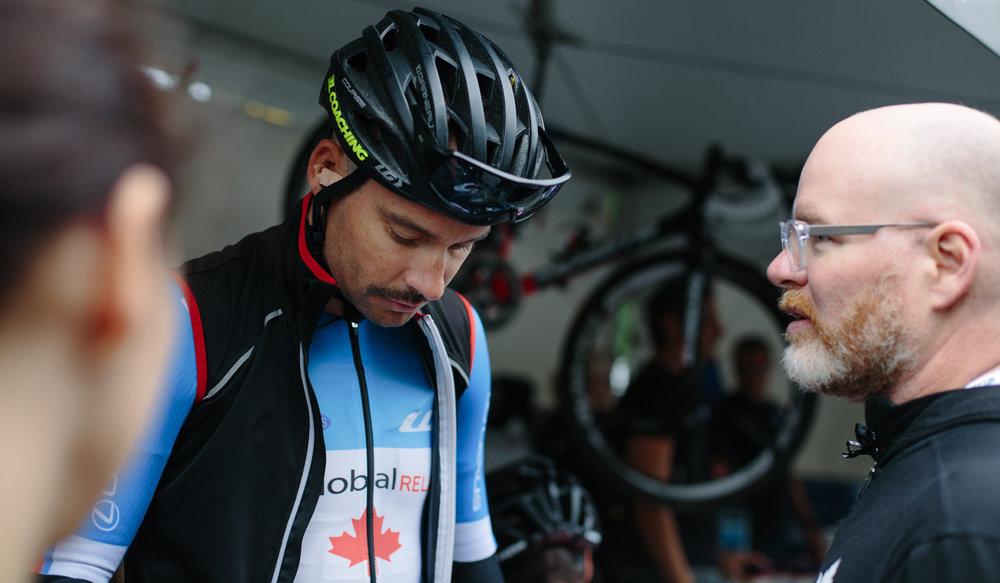
Negative thoughts vs. sporting achievements
It's proven: dwelling on negative thoughts hinders athletic performance.
Science has shown that this phenomenon not only affects morale, but also the proper functioning of the body. Hence the need to change our inner dialogue so that we do not become our own worst enemy.
"I can't do this anymore," "it's too hard," "I'll never get it," "they're stronger than me," "I just want to quit"... Rare are those who have never had this kind of conversation with themselves during training or competition. Sometimes these negative thoughts precede giving up, but more often than not, they can ruin an entire training session or event and destroy our morale.
But worse still, they have a real—and harmful!—influence on our performance.
"This dialogue expresses emotions," explains sports psychologist Bruno Ouellette. "We now know that these negative emotional states use up to 20% more physical energy. If we are angry, frustrated, or discouraged, the heart reacts to this state and beats faster."
The metaphor of the weight we carry on our shoulders has never been more accurate. The dark clouds that cloud our minds slow us down.
And that's not all. "Repeated negative talk also has an impact on the immune system," continues the psychologist, "as well as on problem solving."
The important thing is to believe in it.
The first factor in achieving something is having the conviction that you have the ability to do so. "It's a matter of belief," explains Bruno Ouellette, who has coached several Olympians during his career. "Telling yourself that you are capable of pushing a certain number of watts or covering a certain distance greatly increases your chances of achieving your goal."
This is what psychologists call self-fulfilling prophecies. "It greatly influences physical abilities and tenacity as well."
Be careful with the words you use
Bruno Ouellette often works with athletes to correct their internal dialogue.
He notes that even the way they formulate their goals, when negative, has an influence on their achievement. "You have to choose positive terminology, rather than listing the things you don't want to do. If you say to yourself, 'I don't want to be stressed,' 'I don't want to make mistakes,' you increase the chances that the opposite will happen, and that what you wanted to avoid will happen to you ." So you have to avoid negation.
The language we use has an impact on our performance. "With my athletes, I have banned certain words and expressions. We don't say 'I'll try.' We say 'I'll do it.' Because that's what's going to happen: you're going to pedal. We don't make mistakes, either: we learn.
Emotional vs. rational
In a recent interview with the BBC about Chris Froome's victory in the Giro, Sky's managers explained how the team's psychologist and coach work together to break down preconceived ideas that can lead riders to believe that certain events are insurmountable.
Using empirical data, they contrast their feelings with proven facts: what they believe to be impossible is in fact achievable.
"You have to learn to reframe a situation and not focus on what isn't working," explains Bruno Ouellette, "even though negative thoughts can be useful."
Being frustrated, for example, allows you to express dissatisfaction. This gives you the desire to improve. "It becomes harmful if it continues over time and negative thoughts dominate your inner dialogue," explains the sports psychologist.
It is therefore useful to name these emotions and share them with friends, teammates, or a specialist if necessary. "Negative thoughts are often a symptom of something else: low self-esteem, fatigue, overtraining... You shouldn't deny them, but find a solution."
To do this, you need to stop, reflect, and get to know yourself better to detect any deviations.