
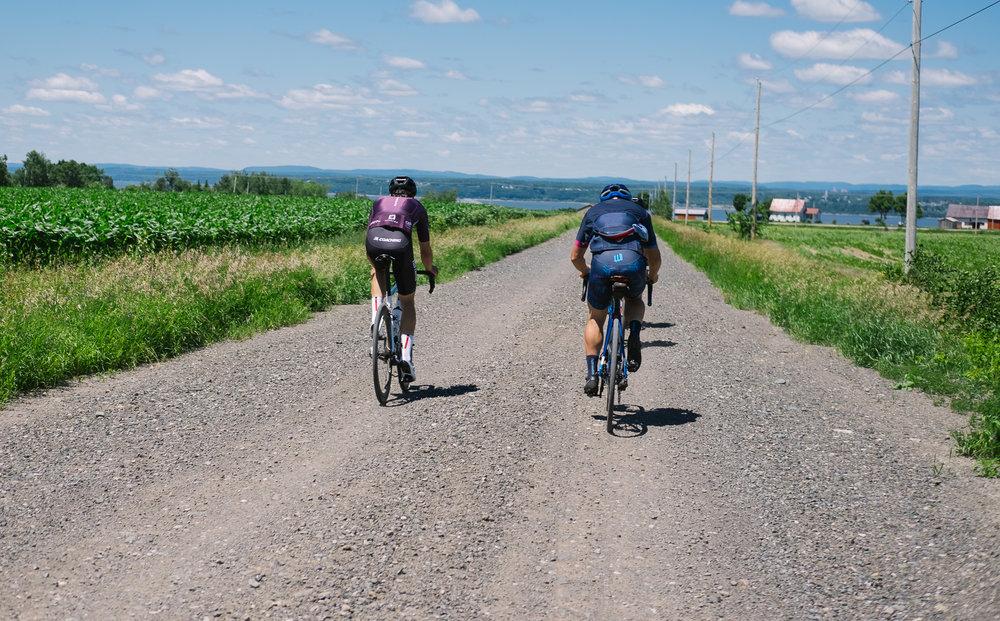
The Gravel Bike phenomenon and Bikepacking
For a long time, the main way to combine "bicycling" with "adventure" was to attach the word "touring" to the luggage rack.
And even then, touring bikes were mostly confined to paved roads.

For trips on dirt roads, road bikes sometimes did the trick. Provided they allowed the use of Tires . And that wasn't always the case, or else this generosity in construction was limited: riding Tires mm Tires was unthinkable. Unless you had a cyclocross bike.
In any case, traditional brake calipers would also have prevented the use of such large tires.
There was mountain biking, but a cockpit lacking in aerodynamics and Tires that Tires wide automatically disqualified it.
Then came the gravel bike.
Enter the landscape
It was the democratization of disc brakes in all areas of cycling that ultimately changed the game.
Suddenly, brakes were no longer a technical constraint. On the contrary, in addition to leaving all the desired space for tires, the disc system now made it possible to slow down in all conditions with the same efficiency. And on a vehicle loaded with luggage, going downhill, it proved to be a godsend.
In line with cyclists' desire for adventure (and perhaps also, for many, the desire to escape roads where the battle sometimes seems lost in advance against trucks, texters, Sunday drivers, and motor enthusiasts), the cycling industry has thrown itself wholeheartedly into the manufacture of gravel bikes.
The goal: to send cyclists out onto all roads, regardless of their condition. And thus open up the cycling territory, responding at the same time to a desire for freedom, to the desire to break free from asphalt and enter the landscape through new doors, conquering new places in our countryside, forests, and mountains.


The bike that does it all?
While their geometry varies greatly, and the slack angles on some gravel bikes confine them to particularly rough trails, paths, and cross-country riding, they all share a slightly higher cockpit position and disc brakes.
Why? Because the position afforded by the cockpit allows for better control on uncertain surfaces. As for disc brakes, in addition to allowing for some tire flexibility, they offer smoother braking that can be adjusted according to the circumstances without locking the wheels. And this is true regardless of terrain or weather conditions.
The growing range of bikes of this type also includes a few gems that have it all. You'll have to make compromises on one aspect or another (agility on the road will often translate into slightly less forgiving handling on gravel, and vice versa), but by choosing your model carefully, you can simply swap out the Tires go from a road machine to a backcountry tank. And sometimes, to a bike for the cyclocross season.
This is the case, for example, with the Chebacco, from Parlee (which you can try out by renting it from Vélo Cartel).


Simpler and lighter to go further
Alongside the development of gravel bikes, the phenomenon of bikepacking has taken off.
Increasingly popular among mountain bikers, whose industry has developed several types of carrying bags better suited to bumps, bikepacking (a term inspired by backpacking, i.e., multi-day self-supported hiking with a backpack) seems poised to take off and replace the more traditional configuration of cycle touring equipment.
For endurance cyclists who want to travel light, for backcountry adventurers who don't want to be weighed down by a traditional luggage rack (which is often too fragile for off-road use), bikepacking is primarily characterized by the use of lightweight, compact equipment and an extremely efficient storage system that allows you to travel far and for long periods of time in complete autonomy.
Most of these products do not require any technical specifications on the bike, unlike luggage racks. Any bike will do, since the bags attach to the handlebars, frame, and saddle.
Events, races
Gravel bike events are gaining momentum. This is particularly true in the United States, where the circuit is growing every year. This is mainly due to the open spirit of most of these races, where participation trumps results. This includes monsters like Dirty Kanza.
Google "gravel bike racing," and a flood of suggestions will fill your screen.
In Quebec, the Classique des Appalaches is a hybrid event, combining road and gravel. In Vermont, the Rasputitsa and Overland races are perfect immersions into this world.
As for bikepacking, its equipment is being adopted in endurance races that are growing in popularity. Such as, for example, the Transcontinental. But since the phenomenon above all allows for immense freedom, all you have to do now is choose a destination and set off.

