
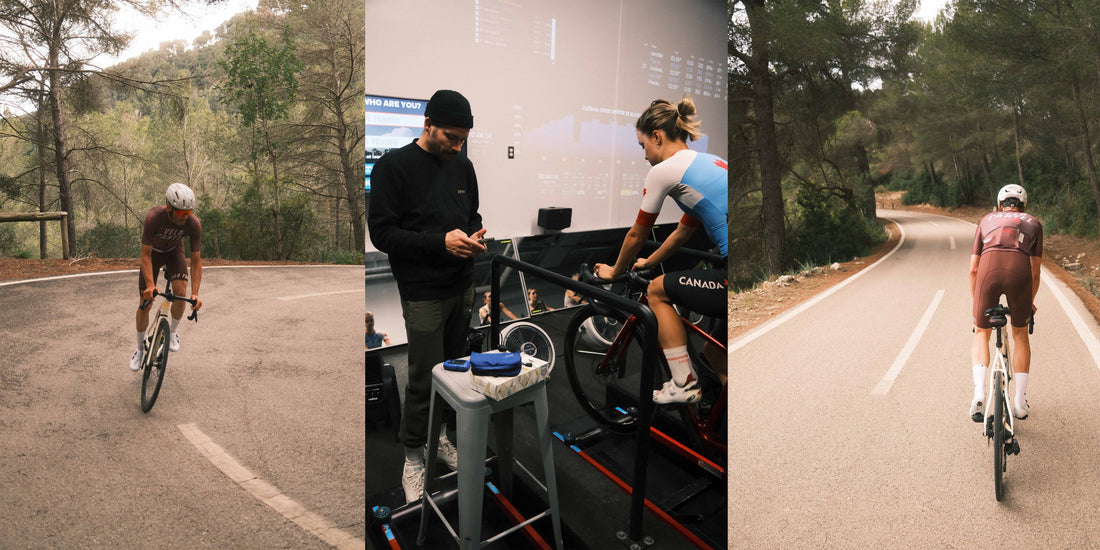
The art and science of inner training at Vélo Cartel
At Vélo Cartel, our goal is always to support cyclists who take their sport seriously by offering them the service their passion deserves: the very best.
Our support in purchasing your equipment and clothing is just as important as our training support.
At the head of our new team of coaches, Bruno Langlois is a role model and mentor.
The former professional cyclist participated in the Tour de Beauce for the umpteenth time last year (he holds the record!) and is part of the Pas Normal international gravel racing team.
His knowledge of physical performance is based as much on his experience as a runner as on solid academic foundations.
With a bachelor's degree in kinesiology from the University of Sherbrooke, the man nicknamed Coach Bru chose to pursue a career in coaching high-performance athletes during his studies. "But I have a broader vision," he insists, "because I understand that you don't train people who aren't professionals in the same way you train people who devote their entire lives to it."
Here, he explains why Vélo Cartel's training room, our team of coaches, and the way his workouts are designed are perfect for getting you in shape and kicking off your next summer season with a bang.
If you had to pitch what training at Vélo Cartel is all about Vélo Cartel a few words, how would you describe it?
It's a place to improve yourself by taking advantage of the group effect, a state-of-the-art system, and above all, a professional team that I train myself, offering training programs based on everything sports science has to offer.
I would also add this: it's really effective. The workout lasts an hour. You take a shower, leave with your recovery smoothie, and presto, you can get back to your life.
How would you describe your general approach to designing your training program for a full indoor season?
I have a reverse planning philosophy. Historically, we spent the winter doing low-intensity volume training, then as we got closer to our seasonal goals, the workouts became more intense and specific. Except that spending hours on the roller at low intensity is boring. And ultimately, what our members want is to get in shape for the upcoming season. So we use the winter primarily to build our power, mainly our VO2 max.
But that's not all we do...
No, no! We work on all disciplines in the same week: in any case, you can't give your best and push yourself day after day without burning out. What's interesting about us is that we get to know our team, we support them as they progress, we test them and we work with them to identify their strengths and weaknesses. Then we make sure we follow them throughout the season and at every training session so that they get the most out of their training.
The improvements you are seeking to achieve with your members are an increase in power in all areas (VO2 max, tempo, sweet spot, zone 2, etc.) throughout the indoor season?
Not only that, no. It's important to take advantage of this opportunity to practice your cadence and different positions on the bike (to be more aerodynamic, for example, while generating a lot of power, which requires flexibility), and I believe that you should focus on working on the things you're least good at. There are creative ways to do this.
What is the main motivating factor for Vélo Cartel members?
It has been scientifically proven that the group effect makes us better. We rarely push ourselves as hard when we're alone in our basement. But I think what people appreciate most is that my knowledge allows me to build training programs over several months that promote their progress, without them having to rack their brains.
What does that mean?
You show up for your two or three training sessions per week and follow the program, knowing that everything we do here is well thought out, meaningful, and designed to ensure progress. You can get your volume (which is also very important) from skiing, running, fat biking, or rollerblading at home. But when you come here, you know it's going to be tough and that you're coming to get that little extra edge to sharpen your form.
What is the role of coaches in all this?
It's extremely important. We have put a lot of effort into building a team of motivated and competent people, both men and women. All of our coaches are or have been competitive cyclists. They have been trained by me for our system. I give them important information about the week's training sessions, and before each session, they explain what the sessions are for and how we are going to stimulate a particular energy system on that day.
The other thing is that we monitor our people. We adjust their effort depending on what's happening. There are also workouts that are designed to fail, so we identify those who succeed and encourage them to raise their level a notch (increase their FTP). In a less structured environment, that won't happen. You'll train with the same values all winter and you won't progress.
What kind of support can we expect, if not?
First, we conduct tests to find out where our clients are at. We adjust their values accordingly, work with them to determine their goals, and decide with them which weekly workouts will be most beneficial for them.
There are several professional athletes who have benefited from your services over the years.
For cyclists who want to go a little further and test their abilities more thoroughly, what services do you offer?
I offer personalized coaching, which can include all kinds of monitoring, such as pyramid tests and lactate tests. These methods allow me to determine training zones more accurately, design better training programs, and conduct quarterly follow-ups to measure progress.