
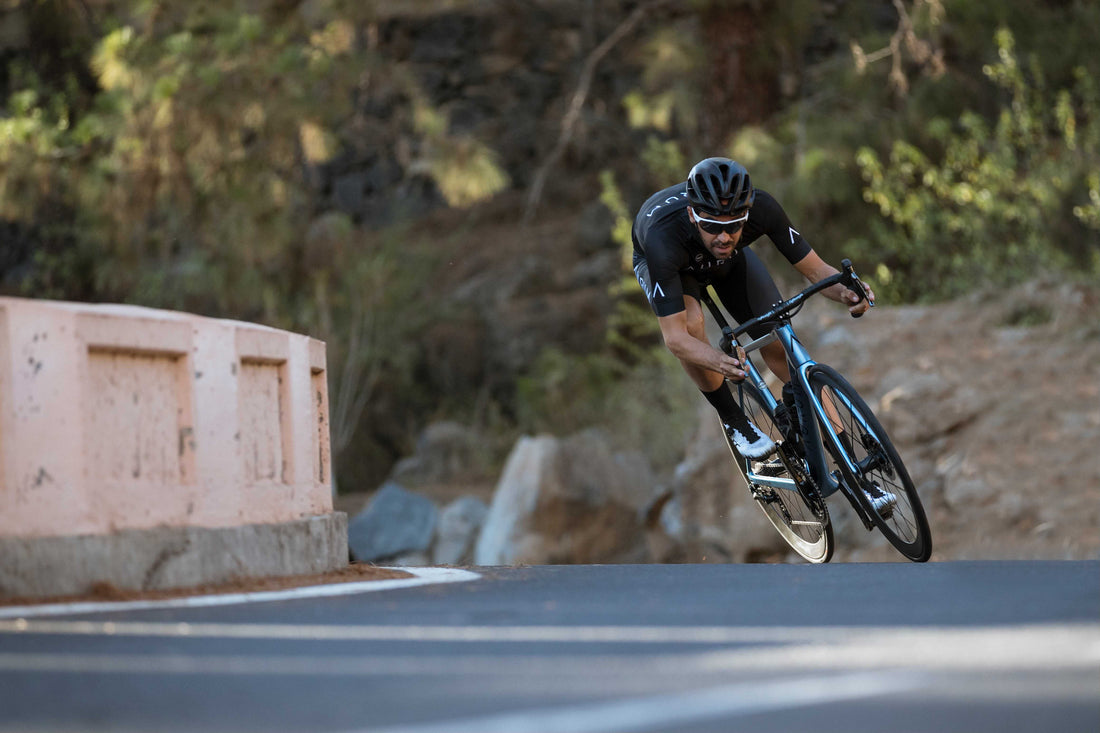
The art of descent
While climbing is a source of pride and proof of fitness, descending is a matter of technique and risk management. It can evoke conflicting emotions, which are all dissolved in the adrenaline rush it provides.
"Death wish!" someone in the group shouted. That was probably me and my questionable sense of humor.
Ten seconds later, I was facing my mortality: my Tires the asphalt in the first of three high-speed turns on the Gagnon hill in Saint-Augustin. The last one was at over 70 km/h. In search of speed, wearing only Socks, I regretted that the moment had been so brief.
Because although I love climbing—for the effort, the sweat, the challenge—nothing makes me as excited and euphoric as a high-speed descent.
It took me a while to grasp the right technique for tackling bends effectively, especially on mountain passes with a series of hairpin turns. Once I got the hang of it, even though I'm far from being an expert at this game, I fell in love with the exercise, approaching it with a kind of fervor that combines excitement, fear, the desire to push my limits, adrenaline, and something like the feeling of living a pure moment, without rough edges, totally extracted from the usual flow of thoughts that pollute the elusive—and coveted—present moment.
There is something reckless, something of a leap of faith, a confidence in my abilities and a search for thrilling experiences in my love of descents. Sometimes I fear them. So I don't expose myself to unnecessary danger. But when the opportunity arises, I rarely balk at a plunge to sea level.
Safety is a matter of judgment, skill, instinct, and luck. There are always uncontrollable variables. On that same Gagnon hill, I once had to "jump" over a branch that was blocking my path, too long to go around. Adrenaline, reflexes, and technique did the trick.
Pleasure and danger
I have a thousand stories of crazy descents and wild chases.
The dive before the climb from Saint-Irénée to the Grand Prix de Charlevoix, in the peloton or at the front, as I tried to gain a little advantage to tackle the brutal climb that followed. The thousand times I rode Les Équerres or Saint-Achillée with my teeth clenched. The blind dives in the fog during the Buckland on gravel. The Tourmalet, passing the caravans. Sa Calobra, saying my prayers.
Even when she runs 10 km, the descent lasts only a moment. And the memory of it is unforgettable.
When pushing yourself to the limit on climbs, you have to silence your instinct for self-preservation and let your experience and skills take over. The same goes for descents, which become even more dangerous if you let fear dominate.
You have to assess the risk carefully. Of falling. Of crashing into a car. Into a tree. Into the bottom of a ravine. Controlling your speed and analyzing the terrain are skills that can be learned. But unlike physical fitness, it's not enough to just string together intervals to develop your riding skills. This is applied physics, learning a skill that, through repetition or innate talent, allows you to get the most out of a descent without putting your life on the line.
Speed is an adrenaline rush. Its fleeting nature and the effort required to achieve it—you have to climb up before or after—make it even more valuable. It must be respected, as we do with experiences where danger and pleasure are so closely intertwined that they command an authority that borders on humility.