
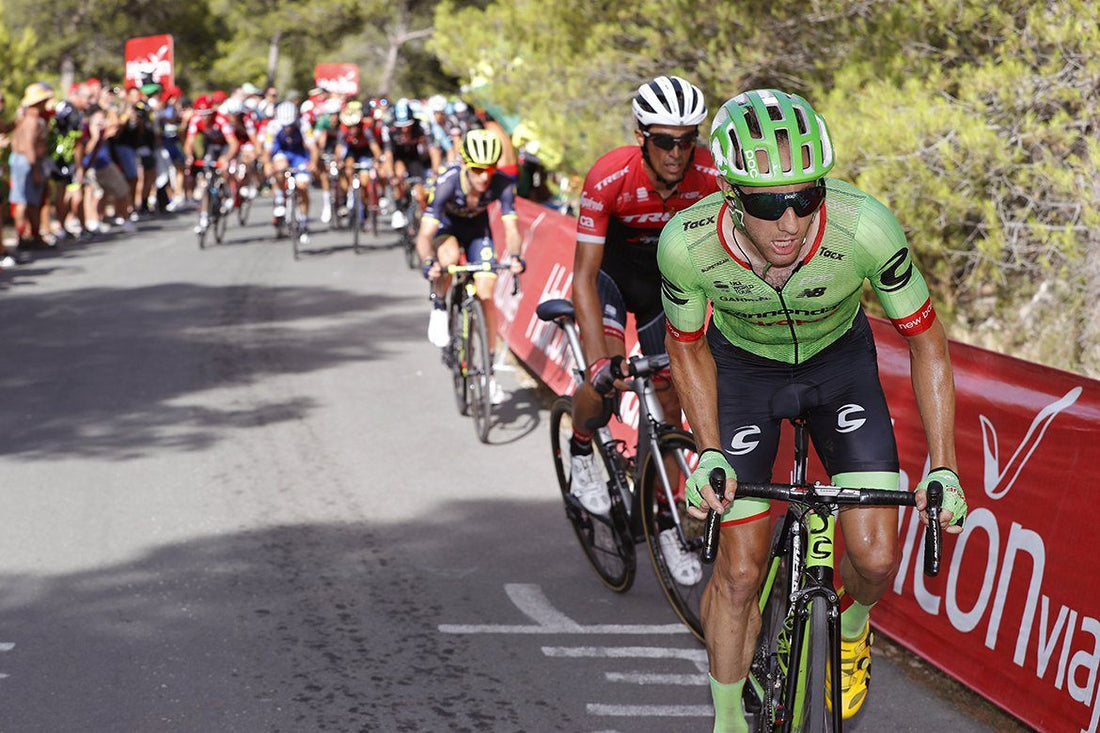
The psychology of performance with Michael Woods
Even the most rigorous training can be undermined by negative thoughts. We discuss this with Michael Woods. The Ottawa native had his most successful season in 2017, finishing stage after stage of a challenging Vuelta alongside the sport's brightest stars. The reason for his success: a major change in his way of thinking, which includes an approach linked to mindfulness meditation.
How would you describe your mental state, your approach to racing?
A lot has changed. Now, I try to focus on simple things. Cycling is such a complex sport, and sometimes so much is happening at once that it's easy to get distracted. So I try to narrow my focus to as few elements as possible during a race.
Can you give us an example?
Generally, I try to keep it to three things that I'm going to focus on. Three, and nothing else. If it's a race with a high-altitude finish, with a long easy segment to start with, then I'll first make sure to stay positive. Because even in a seemingly easier section, it can still go very fast, or it can be boring, or I can get tired, so it's easy to get caught up in negative thoughts. The second thing I focus on is the trust I have in my teammates. So, the certainty that they will get me to the point in the race where I need them and that they will be able to guide me well before the final. And finally, the third point would be not to worry about the climb until I'm there. I don't let my mind wander.
Since you mention it, as you started cycling late in life, you made a lot of mistakes, you fell often, and fitting sometimes difficult. Was there a point where you had a kind of negative inner monologue that you had to fight against?
Absolutely! But over the past year, staying positive has contributed greatly to my success. I realized that, in the past, when I was racing, I didn't particularly want to be there. Not because I didn't want to race, but mainly because of the cold, the pain, the risk of falling... So many things can make you feel bad and make you want to be somewhere else . But last year, I started asking myself: why don't I want to be there? Then I focused on living in the moment and finding pleasure in that moment, even if the conditions weren't favorable. That changed everything. I rediscovered the joy of riding for a living, being followed by fans, and getting incredible equipment.
What you're describing sounds very much like techniques related to mindfulness meditation.
That's exactly it. I'm so obsessed with where I want to be that I forget to live in the moment. That's also why I made a lot of tactical mistakes: I was looking too far ahead in the race. Meditation plays a very important role in this. I try to be less distracted by the Internet and my phone so that I can better enjoy the present moment.
Do you approach training in the same way as running, so that you enjoy it rather than endure it?
When I do easy workouts, I listen to music and talk with friends. But during rides specific rides , I focus entirely on what I'm doing. For example, today I was doing a time trial workout, and the goal of that workout was to be in the moment and feel the effort to really understand what was happening.
And do you break down your workouts like this into smaller chunks to make them easier to handle?
Always! Today, I broke it down into 2.5-minute segments. Also, during the long ones, which are very painful and used to scare me because of their length, I would say to myself, "Oh boy, I'm going to have to suffer for 20 kilometers!" But in the Vuelta, where I had my best performances last year , I never thought about anything other than the next kilometer. I didn't allow myself to think about anything other than the next milestone: I didn't think about tactics or the average power I had put in during the climb. Only the next kilometer. By doing this, you exist only in the present moment and avoid being overwhelmed by the magnitude of the task ahead.
///
Coming soon, in the next article in our Care series, Mike Woods confides: "If it weren't for Bruno Langlois, I probably wouldn't have a career as a cyclist."