ENVE: visionary speed merchant

ENVE: visionary speed merchant

A pair of high-quality wheels can significantly improve your performance, but also how you feel on the bike. In terms of aerodynamics, comfort, and power transfer, carbon wheels have been a game changer in recent years, giving cyclists a more enjoyable overall experience and an undeniable competitive advantage.  

Provided that the product is good.

ENVE, an American company that manufactures its products locally, remains one of the leaders in this field. A model of technological innovation where trust reigns supreme, offering a lifetime warranty on all products.

Over the years, his expertise in the world of carbon, coupled with a solid research and development team in the cycling industry, has enabled him to bring to market products that are considered the benchmark against which others are measured.

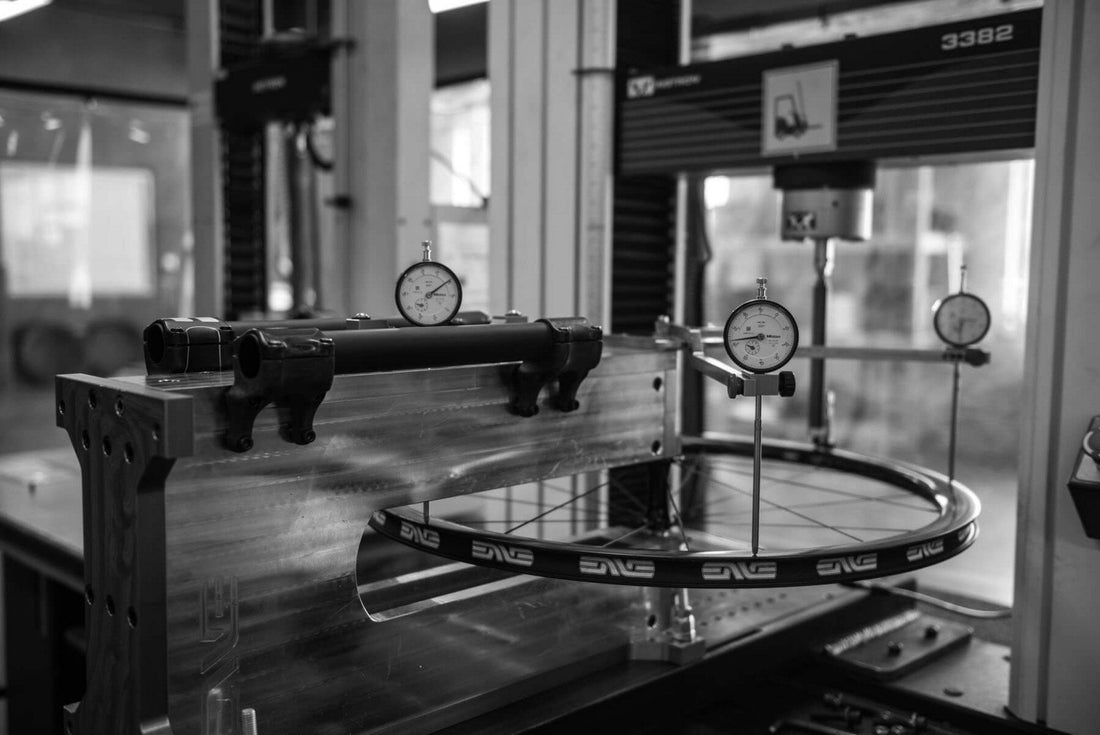
Always ahead of its time, constantly testing its ideas and products, ENVE creates wheels for road, gravel, and mountain biking with the same commitment to excellence: the idea of owning a product whose results are proven and appreciated.

Jack Pantone, Vice President of Products and Customer Experience, answers our questions so we can better understand how ENVE products are created, what drives its designers, and how they envision the future of this market.

First, Jack, how would you describe ENVE's mission?

"Our mission is to provide a better cycling experience through science and the insights gained from real-world experience. The science comes from our knowledge and expertise in materials and manufacturing processes. The field experience that allows us to test our products is gained through our own testing, but also through the repeated and uncompromising use of our products by the professional athletes we sponsor. Finally, those who provide us with the most important feedback remain our consumers."


Why is it relevant to manufacture carbon wheels in the United States when almost all other companies have turned to Chinese or Taiwanese manufacturers?

"Making our wheels here in the United States allows us to be as dynamic as possible. Our principle is to fail quickly, then find a solution to move on to the next step. That's where our competitive advantage lies: by producing locally, we can do internal research and evolve very quickly. That's why we're the most innovative company in the industry.

"What's more, our local production allows us to adjust very quickly to the different waves of a sometimes unstable market. For example, during the COVID-19 pandemic, we were able to quickly reduce production so that we didn't end up with huge surpluses in stock. Another example: when 26-inch wheels gave way to 27.5-inch wheels in mountain bikes, we had very little stock to sell and were not faced with the arrival of containers of 26-inch wheels that had been ordered long ago and would have piled up in our warehouses. The same was true with the advent of disc brakes for road bikes.

"But more than that, manufacturing our products here allows us to have a holistic relationship with them. We know every step of the manufacturing process, which makes us better manufacturers and results in a higher-quality wheel. Finally, we create jobs for nearly 200 local households, and it's definitely easier to protect our intellectual property by keeping production in-house."

What is the story behind the SES series, which has become your "signature wheel" by combining lightness and aerodynamics?

"SES is the result of a development process that culminated in its launch in 2010-2011, but its history began in 2008. At that time, we realized that even though we were producing excellent carbon wheels, we needed to take our game up a notch to offer a product that met the demands of triathletes and road cyclists looking for a competitive advantage in terms of aerodynamics. As luck would have it, that's when we crossed paths with Simon Smart. Formerly an aerodynamics expert in the world of Formula 1, he had since repositioned himself as a specialist in aero optimization for cyclists. His observation was that several models of aerodynamic wheels had a negative impact on the riding experience and sometimes formed a dysfunctional combination with certain frames. His idea was to change the game so that a wheel could be paired with any frame and offer a real advantage to the rider. Together with him, we created and developed the Smart ENVE System (SES) series, which continues to be the industry benchmark for performance and aerodynamics. The shape of the rims and their curves (which we have patented) provide unmatched stability, which is essential for cyclists in an aero position. We also established that front and rear wheels require their own specific shapes and depths to produce the best aerodynamic effect. It's these small details that keep us ahead of the pack." 

Otherwise, how has the design of your wheels evolved in recent years?

"The main change that has affected our industry is undoubtedly the transition from rim brakes to disc brakes. Our SES models have also been expanded to accommodate wider tires and the advent of tubeless technology. We have also committed to producing hookless wheels to improve tubeless performance. On top of all that, it's important to remember that we have been developing and producing wheels for mountain bikes since 2006. This allows us to stay ahead of the pack; our wheels are the gold standard in terms of both weight and strength. We are so proud and confident in our products that we offer a lifetime warranty on all our wheels, regardless of how they were damaged (even during competition or transport), as long as they are ENVE products and you are the original owner.

How has the growing popularity of gravel bikes influenced your recent research and the development of new models?

"We've been having fun off the beaten track for quite some time now! Long before road cyclists set out to conquer dirt roads, we combined our expertise in mountain biking and road cycling to make all our wheels more efficient and durable. Our G Series incorporates the technological elements of our SES and M Series models, and it's our fastest-growing market right now." 

Tubeless tires are becoming increasingly popular on the road, and you have become their advocates. Do you think this is the technology of the future for cycling on paved roads?

"We jumped wholeheartedly into tubeless for road bikes four years ago when we launched the SES 4.5 AR series. This wheel was truly ahead of its time and perfectly designed for use with Tires . We are 100% committed to this path. We believe that a tire should only contain an inner tube in an emergency, i.e., a puncture that requires it. We are working hard to become experts in this field so that we can better equip road and gravel cyclists in their choice of equipment and enable them to install and maintain it more effectively." 

Here are some examples:

Tires  Pressure Tires 
Compatibility 

And why hookless wheels? What difference does it make?

"This is standard practice in all transportation industries... except cycling. Cars, motorcycles, aircraft, and others use this technology because it simply works better with tubeless tires. Technically, this technology allows us to create wheels that significantly improve tire retention on the rim as well as the quality of the seal. Hookless technology has brought to light deficiencies in the manufacture of tubeless wheels for road use, prompting the entire tire industry to adapt very quickly and improve Tires that they are completely effective and safe, even without hooks."

You have just launched a new series, Foundation, which is more affordable. Can you describe it to us and explain how you managed to reconcile your requirements with more modest budgets?

"From the outset, even though the series was designed to be less expensive than our SES, we didn't want to compromise on quality. So we looked at our production process to see where we could reduce costs. We achieved this, for example, by offering rims of the same depth at the front and rear, which has very little impact on performance. In the production line, we also simplified the carbon lamination method, reducing production time by two-thirds compared to our SES series. The result is a wheel that is slightly less aerodynamic, a little heavier, and perhaps a little less refined than the SES, but overall, the differences are minor, and we have managed to maintain an overall quality that, in our opinion, far surpasses what our competitors offer in the same price range.

Back to blog