
David Desjardins guest cyclist: Vivre vite vivre fort
Live fast, live strong
We have coffee in Le Monêtier-les-Bains in a small bar that resembles itself as a saloon. The terrace offers a breathtaking view of a parking lot with about ten spaces. The main street in front still bears traces of the Tour, which passed through a few weeks earlier. Above the road, strings of yellow, green, and white polka dots flutter in the hot wind like the sirocco.
For most of the other members of our organized trip's crew, the day is practically over. In the morning, we left the Hôtel du Soleil in Aussois to embark on a long descent towards Saint-Michel-de-Maurienne. A descent to take a photo of France from Socks : deserted villages, abandoned industrial buildings, roads widened to make way for progress that here takes on the appearance of a zombie. The entrance to the Col du Télégraphe is as discreet as the climb is beautiful: forested, steady, without any overly demanding ramps. An aperitif before the Galibier, which, from Valloire, takes us up another 1,200 meters over 17.6 kilometers. Average gradient: 7.6%.
It reminds me of the Tourmalet: you can handle it, you can handle it. But on the end, the last hairpin turns become increasingly difficult. Until the last kilometer, when the prospect of the finish line gives you wings. Even if your legs don't.
There's a crowd at the summit. Mostly motorcyclists. I hate them: they're the most dangerous on these roads because they can go up and down much faster than cars. They regularly brush past us (cars do so much less often), arriving so fast that they take us by surprise and sometimes recklessly overtake us on bends. They pose in front of the signs at the top of the passes, grinning stupidly, proud as if they themselves had provided the horsepower to get there.
The descent to Monêtier is wide, fast, and much more conducive to downhill. The speedometer rarely drops below 70 km/h, a sign that the turns are wide and require little or no braking. We take turns in the lead, pumped full of adrenaline, pedaling hard to pick up speed or to prevent our legs from stiffening after the effort of the climb.
So we could have stopped everything once we arrived in Monêtier, with our coffee. That's where the hotel is. Our luggage will be dropped off there in a few minutes. According to the official itinerary for the trip we're on, today's activities end here.
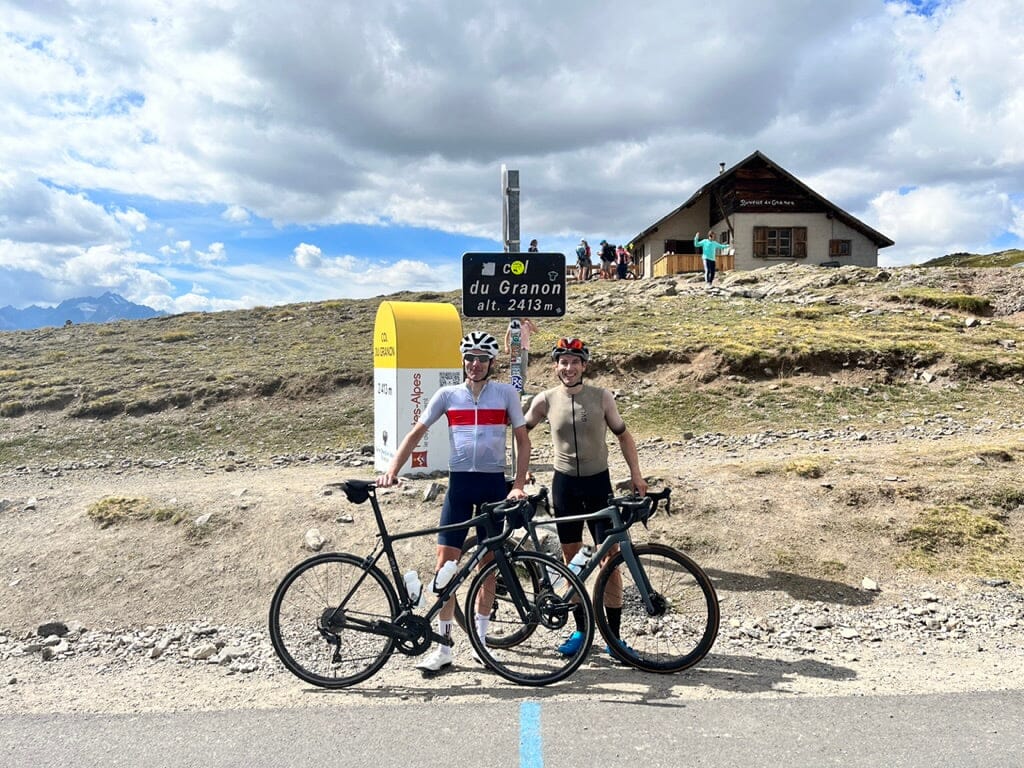
Except that, right next door in Briançon, there is Le Granon. An unsung gem of that year's Tour. The battlefield where Pogačar fell. A formidable climb, almost always at 10% for the last 10 kilometers, with no flat sections. No respite, then.
Many long minutes later, the photo of me taken at the top says it all: the 60 times I desperately searched for one more gear that I didn't have; the advantage my friend Shan gained over me by setting a very tough pace from the start; the moment he left me behind; the moment when, passing in front of the fences of the military training area, I pushed myself forward with sheer courage; and what I left of my soul to catch up with my opponent. I enlarge the image. I am pale. Literally drained of blood. My Helmet (still) crooked.
These memories come flooding back as I write these lines, along with the feeling of being in a body that is washed out, wrung out. I watch people tucking into slices of blueberry pie in the tiny café upstairs and my heart sinks. The 300-meter climb that separates us from the hotel via the Col du Lautaret (because after descending, we have to climb a little more to get home) seems obscene to me. It's only mid-afternoon. The sun is beating down. I dream of a Coke, a Perrier, a beer. It will come. In a few minutes, the day will be just another story to write down in the notebook of memories. Another crazy adventure that we impose on ourselves to live fast, to live hard.