
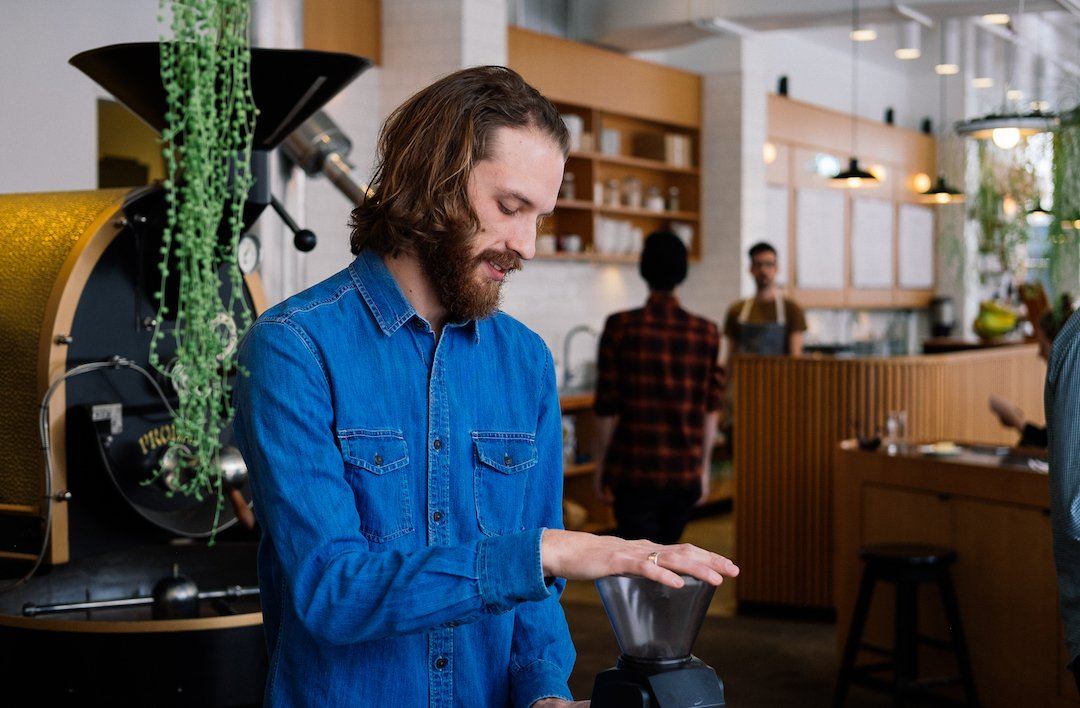
Café du Cartel: surf the third wave
While cycling is the common ground for those who frequent Vélo Cartel, coffee is the social lubricant.
Our standards in this area are comparable to everything else: whether it's bikes, clothing, or drinks, we promote quality products that we appreciate for their finesse.
Explore a world of flavors
Like wine, coffee has its own unique aromas. You can learn how to taste it, discover the varieties you like—or dislike—and develop your taste for it. This begins with a quick introduction to this world.
At Vélo Cartel, we have partnered with Saint-Henri, a micro-roaster that imports its beans directly from producers for its signature products, with a focus on sustainable and fair trade.
What is the third wave?
When it comes to specialty coffee, we often talk about the third wave.
But what exactly does that mean, and what are the other two waves? Let us explain.
Coffee became popular during the two world wars. At that time, the drink was all the rage among soldiers, and that's when it became part of the daily routine of North Americans.
At the turn of the 1960s and 1970s, the second wave established the drink, which was now available in different forms: mainly brewed in a filter on this side of the Atlantic, and as espresso among our European friends. This was the era of Colombian coffees and major brands such as Maxwell House, as well as strong marketing figures such as Juan Valdez. This wave continued into the 1990s, while neighborhood coffee shops and large companies such as Starbucks changed the way we consume coffee, bringing it more in line with European tradition.
When coffee becomes like wine
The third wave, which is very recent, is only about twenty years old. It marks an era of refinement in which coffee production has come to resemble wine production in terms of the approach to terroir, fruit varieties (because, let's not forget, coffee is originally a bean surrounded by pulp and flesh), and the search for specific flavors through roasting methods—i.e., cooking coffee at very high temperatures.
Here we are, constantly deepening our knowledge and comparing the subtleties of one coffee to another. Some are more floral or fruity. Others are acidic or sweet. We detect hints of cherry, molasses, citrus, and spices.
Added to all this are the different ways of enjoying it. Very short and strong, for its creamy texture and pronounced flavor. With milk, for those who cherish this divine combination. Or filtered, to saturate the taste buds with rich aromas.
“Everyone has their preferences,” says Nicholas Ladouceur, roaster at Saint-Henri. “There are coffees that are excellent in absolute terms, but that we don’t necessarily like because they are too acidic or too fruity, and that’s normal. The important thing is to try several varieties to discover what you like.”
We would be delighted to accompany you on your journey of discovery. Come and see us. Tell us what you like best. Let us give you a taste of some of our products, and let's continue our exploration of coffee together. This is just the beginning. The third wave has only just begun.
Our cafés
We mainly use Holycow coffee from Saint-Henri, a blend that suits most people. But we also sell the main products from this excellent roaster. Here is an overview to help you begin your exploration.
Introduction: Colosseum
If you are used to Italian-style espresso, well roasted, with a chocolate aroma, and you want to continue in this vein, Colosseo is perfect for you.

The master key: Holycow
This is Cartel's house coffee. Less robust than Colosseo, it borrows a slight bitterness from Godshot, making it an ideal gateway for explorers who want to venture into more fruity flavors.

The key to the fields: Godshot
Godshot is the signature espresso of our partner, Saint-Henri. It is a tangy, fruit-forward coffee that produces a high-quality brew for those who stray from the beaten path to ride the third wave to the fullest.
